








This website has been archived from TrainWeb.org/cfa to TrainWeb.US/cfa.
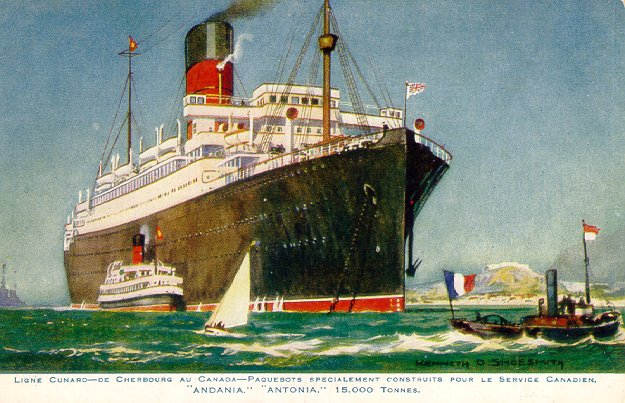
| Andania and Antonia were
the first two of the six 14,000 ton "A" liners built for Cunard
in the early 1920's.
Built by Hawthorn, Leslie & Co., Andania was launched in 1921 and made her maiden voyage from London to Montreal on 1 June 1922. She was transferred to Cunard's Hamburg-New York route from 1924 to 1926, and from 1927 to 1939 was on a Liverpool-Greenock-Belfast-Montreal service operated jointly by the Cunard, Anchor and Donaldson Lines. Requisitioned for service as an armed merchant cruiser in 1939, Andania was torpedoed and sunk off Iceland by German submarine UA on 16 June 1940; she remained afloat long enough for all aboard to be rescued. Antonia was built by Vickers, Ltd., and launched in 1921. She made her maiden voyage from London to Montreal on 15 June 1922. She remained on Cunard's London-Canada service until 1928, when she joined Andania on the Cunard/Anchor/Donaldson joint service. Antonia, too, was requisitioned during World War II, and served as a troop transport and later as an armed merchant cruiser. She was purchased by the Admiralty as a repair ship in 1942, and renamed Wayland. She was scrapped in 1948. Sources: Haws' Merchant Fleets; Bonsor's North Atlantic Seaway; Williams' Wartime Disasters at Sea. |


ENCYCLOPÆDIA BRITANNICA
Andania mysteries
Ancient Greek mystery cult, held in honour of the earth goddess Demeter and
her daughter Kore (Persephone) at the town of Andania in Messenia. A long inscription
of 92 BC gives elaborate directions for the conduct of the rites, although it
relates no details of the initiation ceremonies. The ritual was performed by
certain "holy ones" of both sexes, who were chosen from the various
tribes, presumably the same number from each tribe.
Initiation seems to have been open to men, women, and children, bonded and free,
and some details have survived as to the costumes to be worn by each class of
initiates: all costumes were to be severely plain and of inexpensive material.
An exception was made for those who were to be "costumed into the likeness
of deities," from which many scholars have assumed that a pageant or drama
was performed. There was a procession, precedence in which was strictly regulated,
and the main ceremonial was preceded by sacrifices to a number of deities.