







This website has been archived from TrainWeb.org/oldtimetrains to TrainWeb.US/oldtimetrains.
 |
|
 |
|
Canadian Pacific Railway
London Division Changes Over the Years Expanding traffic not only required bigger yards in London and Windsor, not to mention Toronto; it also required double tracking. Starting in 1904 between Parkdale and (West) Toronto Jct. and in 1911 to Obico, (except for the Humber River bridge which got by with a gauntlet track until it was rebuilt in 1914). In October 1912 it was added from Obico to Cooksville, and in 1913 it went on to open to Guelph Junction by the end of November. Surveys were also completed for double tracking to Woodstock where branches connected with the main line; but it was not to be, for there the double track ended, far short of London. It was not until the start of GO trains October 26, 1981 between Toronto and Milton, that a third track was added to parts of the Galt Sub. between Toronto and Streetsville. Bi-directional CTC was also installed to replace ABS signaled for one direction only. Guelph Jct. yard was rebuilt to accommodate over night storage of the commuter trains. Rail was upgraded by 1930 to 100lb. between Montreal and Windsor, and this 39' long bolted rail safely handled Royal Hudson's at 90 mph and Jubilees at well over 100 mph! In 1977-82 rail went to 115lb, and with the advent of GO commuter trains, 136 pound CWR (1980-81) on the portion of the Galt Sub. used by GO. Automatic Block Signals (ABS), had been installed on the Windsor Sub. over an eight month period beginning March 1,1944. It required 148 high signals and 40 dwarfs (on passing tracks) for the 108 miles from London to Walkerville Junction. It also required a major re-arranging of the 6 miles of ABS from London to Lobo. A total of 1,475 miles of ABS then existed on Eastern Lines. The first ABS of this type went into use early in 1944 between Chapleau and Schreiber. ABS was later added to the Galt Subdivision.
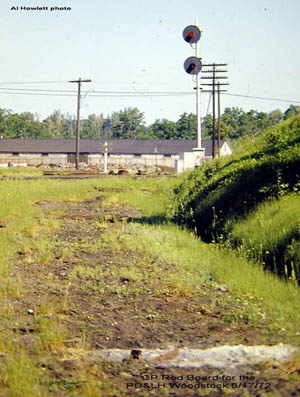
Train orders issued by dispatchers and written out by Operators all along the line were the way trains operated all across Canada for more than a century. It all came to an end when a new system known as Manual Block System (MBS) was introduced whereby Operators were eliminated and Conductors wrote out their train's authority to operate by radio instruction issued by train dispatchers. Its passing included removal of the familar train order signal or, order board, as it was commonly called, from stations all along the line. London Division was changed effective 0001 July 6, 1986. The London Division was combined with the Toronto Division October 27,1991. RoadRailer trains began operating May 15,1991 and were the most innovative change to the London Division. Triple Crown Service, a subsidiary of Norfolk Southern in the USA operates a network of these trains over its lines. This was the first time RoadRailer trains were operated in Canada or anywhere else off NS. These trains consist of specially-reinforced highway trailers connected to each other. Early models had steel rail wheel sets along with the rubber tires. Later versions used "bogies" or special trucks in place of tires. Early trains were restricted to 75 trailers, while later ones were re-inforced to allow 125 trailers. These trains operated on CP between Detroit and Lambton Yard in west Toronto. Eventually, the service was re-routed by NS over CN. Expressway is another method of handling highway truck trailers on flat cars. Expressway trains began operating over the London Division between Detroit and Milton (Hornby) in June 2000 following relocation of the Toronto Terminal from Lambton Yard. Frame train: A DTS (Dedicated Train Service) itself a little-known term, operated since 1998 between St.Thomas and Oshawa without change of crew or power at Toronto Yard. It handled new frames from Formet (Magna International) in St.Thomas to General Motors in Oshawa. Declining pickup truck sales made for a big reduction of traffic and resulted in the "frame train" being discontinued in August 2008 with the remaining cars being handled by regular trains. Eventually, GM closed the truck plant permanently May 14, 2009. Melrose: Just west of London is Melrose, a new point on the Windsor
Subdivision. Previously at Mileage 11.8 just a diamond with the CN Strathroy
Sub. (Mileage 12.2) existed west of Komoka (M. 9.8). A new connection
was opened at 1400 February 2, 2001 between CP and CN allowing some CP
trains and crews to operate between London and Sarnia and to use the new
tunnel enroute over the old GTW to and from Chicago. Back (Use your browser Back button) |
|
|
|
|




 ...
...